As wheat planting approaches in North Carolina, weed management decisions made before and shortly after planting will dictate whether we can achieve season-long control. This is especially true for Italian ryegrass, which drives most weed management decisions in our state.
Getting Ahead of Italian Ryegrass in the 2026–2027 Winter Wheat Season
Step 1. Start clean with an effective burndown.
Starting with a clean field before wheat planting is critical, but this has become increasingly challenging as Italian ryegrass populations across North Carolina have developed resistance to several of our key herbicides. A recent statewide survey of populations collected from wheat fields with observed ryegrass escapes identified resistance to mesosulfuron (Osprey), pinoxaden (Axial XL), glyphosate (Roundup PowerMax 3), and paraquat (Gramoxone 3.0), including populations with two-, three-, and four-way multiple resistance (Figure 1).
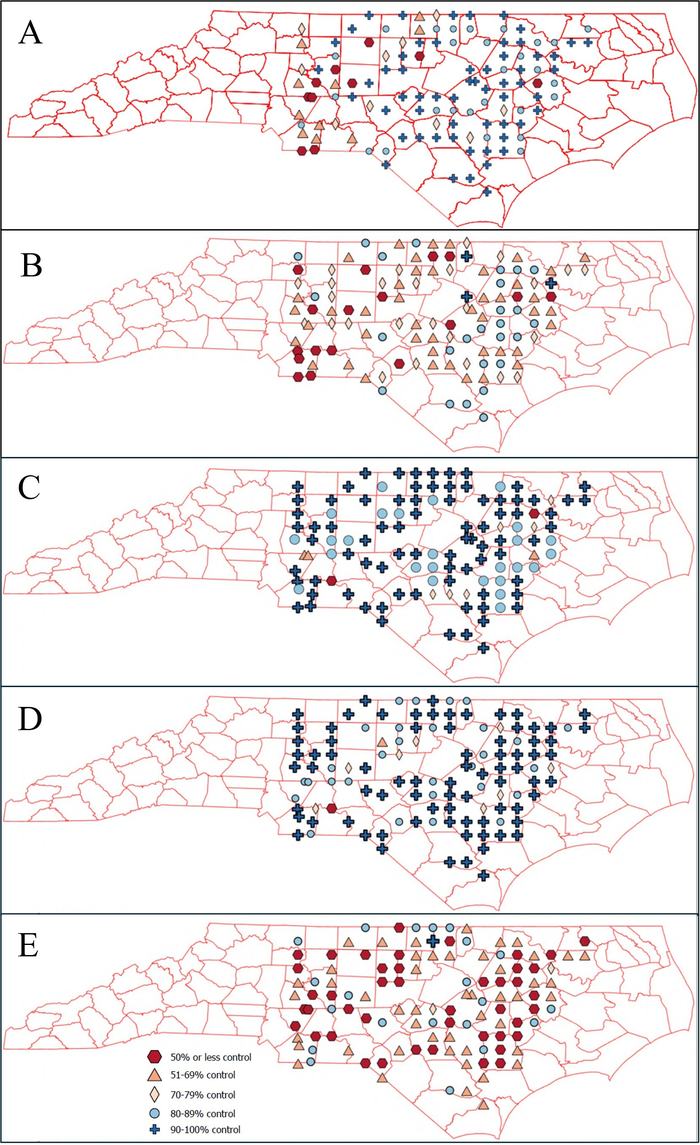
Figure 1. Distribution maps demonstrating control for all populations with herbicides mesosulfuron (A), pinoxaden (B), glyphosate (C), paraquat (D), and glufosinate (E). Adapted with permission from Alsdorf et al. (2026), Weed Technology.
Where glyphosate-resistant Italian ryegrass is suspected, paraquat remains one of our primary burndown options ahead of wheat. Remember that paraquat is a contact herbicide with no residual activity, so weed size and spray coverage are critical. Target small ryegrass plants and use adequate carrier volume. We suggest at least 15 GPA, with 20 to 40 GPA preferred for ground applications of paraquat. The current Gramoxone label also requires medium or coarser droplets.
Availability of paraquat will soon change. Syngenta now confirms that Gramoxone production has ceased, with sales ending by December 31, 2026, or when existing supplies are exhausted. Importantly, this does not mean paraquat is going away. Other paraquat formulations are currently available and may remain on the market, but growers should check individual product labels and availability.
If Italian ryegrass in a field remains susceptible, glyphosate remains an effective burndown option. However, repeated failure with glyphosate, or a history of confirmed resistance, is a good reason to choose another effective strategy. Fields with resistance to both glyphosate and paraquat require a different approach. Waiting until wheat planting may leave few effective chemical burndown options. Where ryegrass remains susceptible to clethodim, an earlier Select Max treatment may be an option, but wheat must not be planted until at least 30 days after application.
Future research investigating additional burndown options ahead of wheat is planned; stay tuned for results.
Step 2. Keepin’ it clean with a residual herbicide.
Once you control emerged ryegrass, the next step is choosing a residual. Pyroxasulfone-containing products such as Zidua SC, Anthem Flex, and Fierce EZ are excellent options for residual Italian ryegrass control in wheat. While all three contain pyroxasulfone, differences in additional active ingredients and labeling provide some flexibility in application timing (Table 1).
Zidua SC can be applied delayed pre-emergence (PRE) (once 80% of germinated wheat have shoots at least ½ inch long), before wheat spiking, as well as early post-emergence (POST). Anthem Flex can be applied PRE in North Carolina under a 24(c) supplemental label, in addition to delayed PRE and early POST timings. There are increased risks for wheat injury on coarse soils with Anthem Flex applied PRE. Please look at the 24(c) supplemental label for further details regarding Anthem Flex applications PRE. Fierce EZ can be applied at least 14 days before planting or from approximately wheat spiking through the 2-leaf stage. When applying Fierce EZ preplant, there are risks of pyroxasulfone moving into the seeding zone before wheat germination, which can cause significant injury.
| Table 1. Pyroxasulfone-containing products and application timings for Winter Wheat. | ||
|
Product |
Active ingredients |
Timing |
|
Anthem Flex |
pyroxasulfone + carfentrazone |
PRE*, delayed PRE, early POST through 4-tiller |
|
Zidua SC |
pyroxasulfone |
Delayed PRE through 4-tiller |
|
Fierce EZ |
pyroxasulfone + flumioxazin |
14 DPP** or spike to 2-leaf |
|
*Anthem Flex PRE use requires the NC 24(c) label (NC-160004). Valid through December 31, 2026, unless withdrawn, canceled, or suspended. |
||
Recommending the “best” pyroxasulfone timing is difficult; each option has pros and cons. Applying pyroxasulfone at planting provides residual activity against early-emerging ryegrass. Delaying the application may shift more residual activity later into the fall and potentially improve control of later-emerging ryegrass. However, delaying the residual is not always better, especially if ryegrass emerges before application. Pyroxasulfone has little to no activity on emerged ryegrass. If ryegrass emerges before the delayed application, you will need to control those plants with another herbicide. Fields with a history of heavy early emergence may benefit from getting the residual out sooner, while delayed applications may have more value where ryegrass emergence tends to be prolonged. There is risk for crop injury when applying pyroxasulfone products prior to wheat emergence. Following product-specific planting-depth, seedbed, soil, and rainfall restrictions reduce the risk of wheat injury.
Rainfall following application is also important. Pyroxasulfone requires moisture for activation, and approximately 0.5 inch of rainfall or irrigation may be needed for optimum activity. Applying pyroxasulfone earlier may also increase the likelihood of rainfall before ryegrass emergence, improving the chance the herbicide activates in time. Extended dry conditions following application can reduce residual control.
Consider the broader weed spectrum when selecting a product. Fierce EZ contains flumioxazin in addition to pyroxasulfone, which can provide additional residual control of several broadleaf weeds.
We still need more North Carolina data to determine how pyroxasulfone timing influences the length and consistency of Italian ryegrass control. Future research will evaluate PRE and delayed-PRE applications to better understand where these timings fit across different ryegrass emergence patterns and environmental conditions.
For additional herbicide options, rates, application timings, and weed control recommendations in wheat, refer to the 2026 North Carolina Agricultural Chemicals Manual.
References
Alsdorf JW, Contreras DJ, Cahoon CW, Jennings KM, Everman WJ. 2026. Distribution of Italian ryegrass [Lolium perenne L. ssp. multiflorum] resistance to postemergence herbicides across North Carolina. Weed Technology. Published online: 1–22. doi:10.1017/wet.2026.10137.
Legleiter T. 2026. Residual herbicides are also beneficial in wheat. University of Kentucky Extension, Kentucky Pest News. 2(8). August 14, 2026.