

Calcium Deficiency of Carinata
go.ncsu.edu/readext?520091
en Español / em Português
El inglés es el idioma de control de esta página. En la medida en que haya algún conflicto entre la traducción al inglés y la traducción, el inglés prevalece.
Al hacer clic en el enlace de traducción se activa un servicio de traducción gratuito para convertir la página al español. Al igual que con cualquier traducción por Internet, la conversión no es sensible al contexto y puede que no traduzca el texto en su significado original. NC State Extension no garantiza la exactitud del texto traducido. Por favor, tenga en cuenta que algunas aplicaciones y/o servicios pueden no funcionar como se espera cuando se traducen.
Português
Inglês é o idioma de controle desta página. Na medida que haja algum conflito entre o texto original em Inglês e a tradução, o Inglês prevalece.
Ao clicar no link de tradução, um serviço gratuito de tradução será ativado para converter a página para o Português. Como em qualquer tradução pela internet, a conversão não é sensivel ao contexto e pode não ocorrer a tradução para o significado orginal. O serviço de Extensão da Carolina do Norte (NC State Extension) não garante a exatidão do texto traduzido. Por favor, observe que algumas funções ou serviços podem não funcionar como esperado após a tradução.
English
English is the controlling language of this page. To the extent there is any conflict between the English text and the translation, English controls.
Clicking on the translation link activates a free translation service to convert the page to Spanish. As with any Internet translation, the conversion is not context-sensitive and may not translate the text to its original meaning. NC State Extension does not guarantee the accuracy of the translated text. Please note that some applications and/or services may not function as expected when translated.
Collapse ▲From the Field – Agronomy Notes


In this Brassica carinata (Ethiopian Mustard) research update, we highlight the symptoms of calcium deficiency. These images are part of a project by the Southeast Partnership for Advanced Renewables from Carinata (SPARC) to develop a diagnostic series for the identification of nutrient disorders of Carinata. Carinata is an exciting new crop in the Southeast used for a wide variety of primary and secondary agricultural products including cover crops, feedstock, high protein meal, and jet fuel. It is similar in management to canola given both canola and carinata are winter annual Brassica oilseed crops. However, carinata oil is not edible.
Diagnostic Information:
Calcium (Ca) is bound as cellular structures in plants, and is consequently plant-immobile. This means symptomology will manifest on the new growth rather than older foliage. The first sign of calcium deficiency will be evident on the growing tip, showing a curling of the margin of the new leaves (Fig. 1). These new, expanding leaves will appear to develop normally except for the leaf margin, which will curl either inward or upward resulting in a cupping of the leaf (Fig. 2). The leaves may also have small brown spots randomly distributed toward the petiole near the margin of the leaf (Fig. 3).
The next stage of calcium deficiency results in general interveinal chlorosis of the new growth, particularly near the petiole (Fig. 4). As the developing leaves continue to expand, the center of the leaf will expand while the margin does not, resulting in a more dramatic cupping of the leaf and occasionally splitting or cracking near the leaf margin. In more advanced stages, the leaf will turn from interveinal yellowing to interveinal reddening or purpling (Fig. 5).
The final and most advanced stages of calcium deficiency result in severely distorted growing tips which appear as spiked petioles (Fig. 6). The growing tip will eventually die, resulting in the proliferation of axillary shoots (Fig. 6). These shoots will also appear as unexpanded leaves or spiked stems. To ensure proper diagnosis the above material should be used in conjunction with a leaf tissue sample and/or field test.
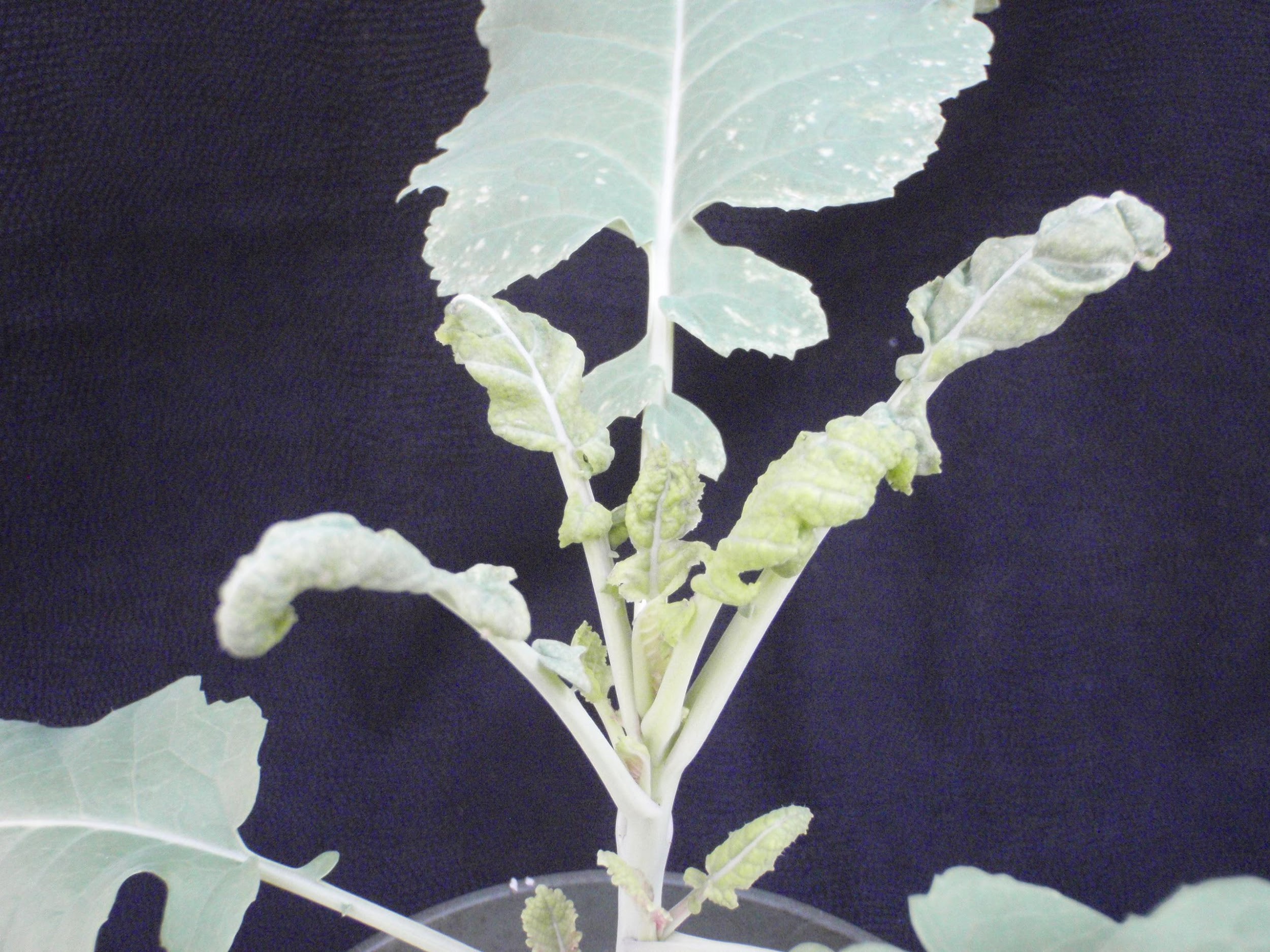
Figure 1: Note the new, expanding leaves. They are exhibiting deformation especially along the margins. As calcium becomes limited, the leaf surface will continue to grow and expand however, the leaf margin will remain stunted causing an inward curling of the leaf. ©2018 Forensic Floriculture
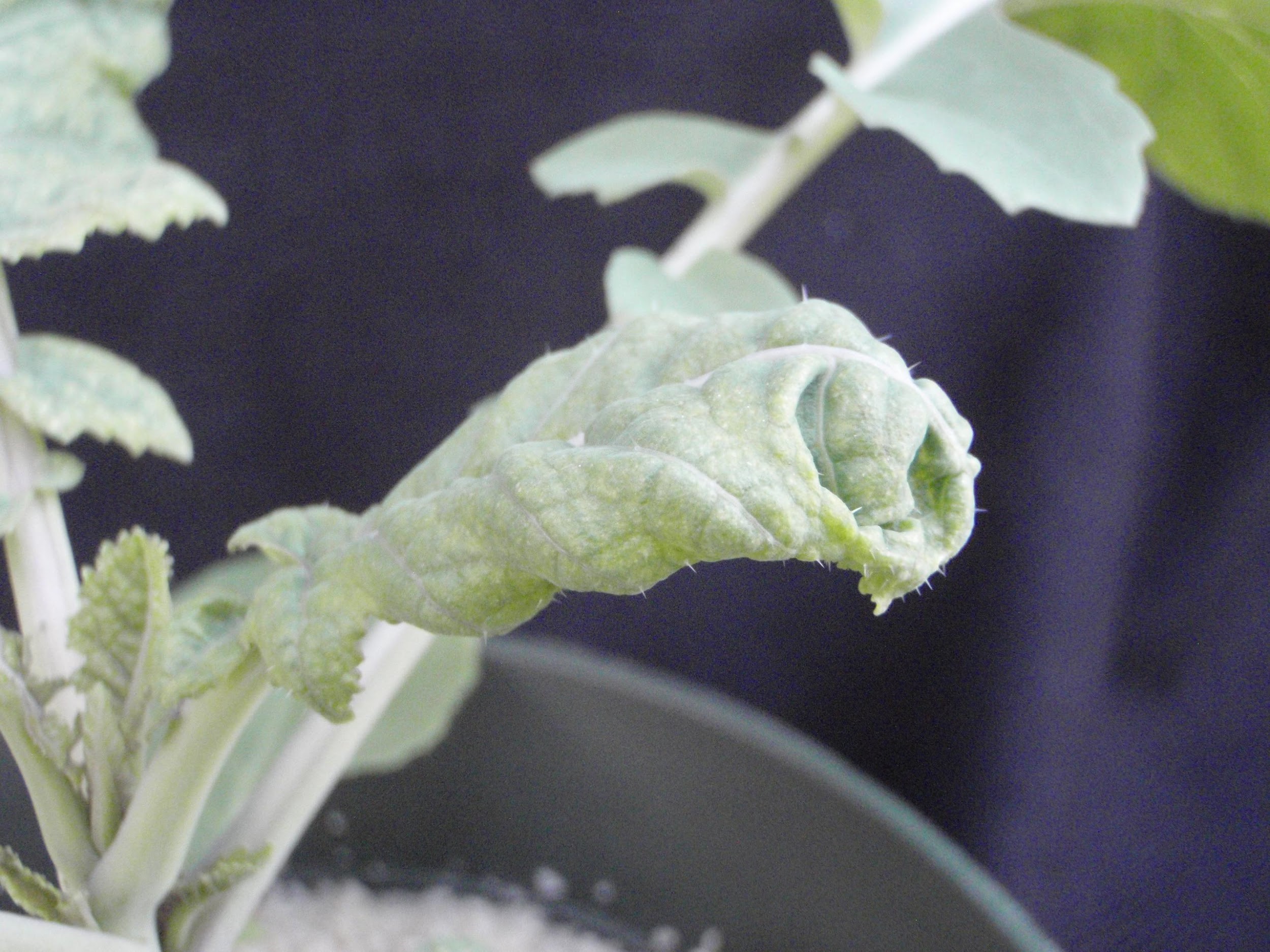
Figure 2: As calcium deficiency symptoms progress, the new leaves will continue to expand in the center however the leaf margin will remain undeveloped. This causes the leaf to distort and curl inward on itself forming a hood like structure. ©2018 Forensic Floriculture
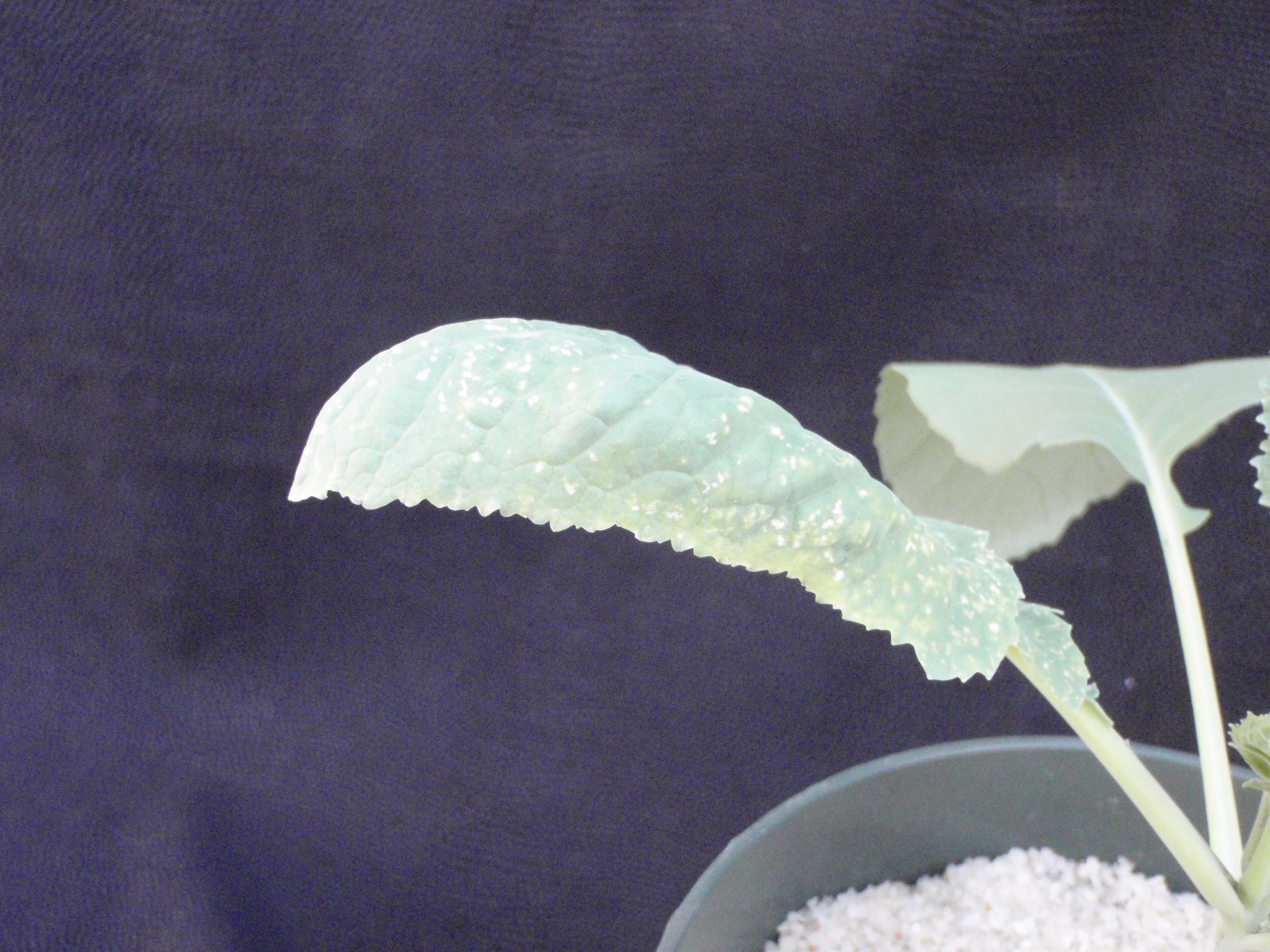
Figure 3: In addition to the marginal curling of the new foliage, the leaves will also develop necrotic brown to tan spots. These will become more severe and larger as symptoms progress. ©2018 Forensic Floriculture
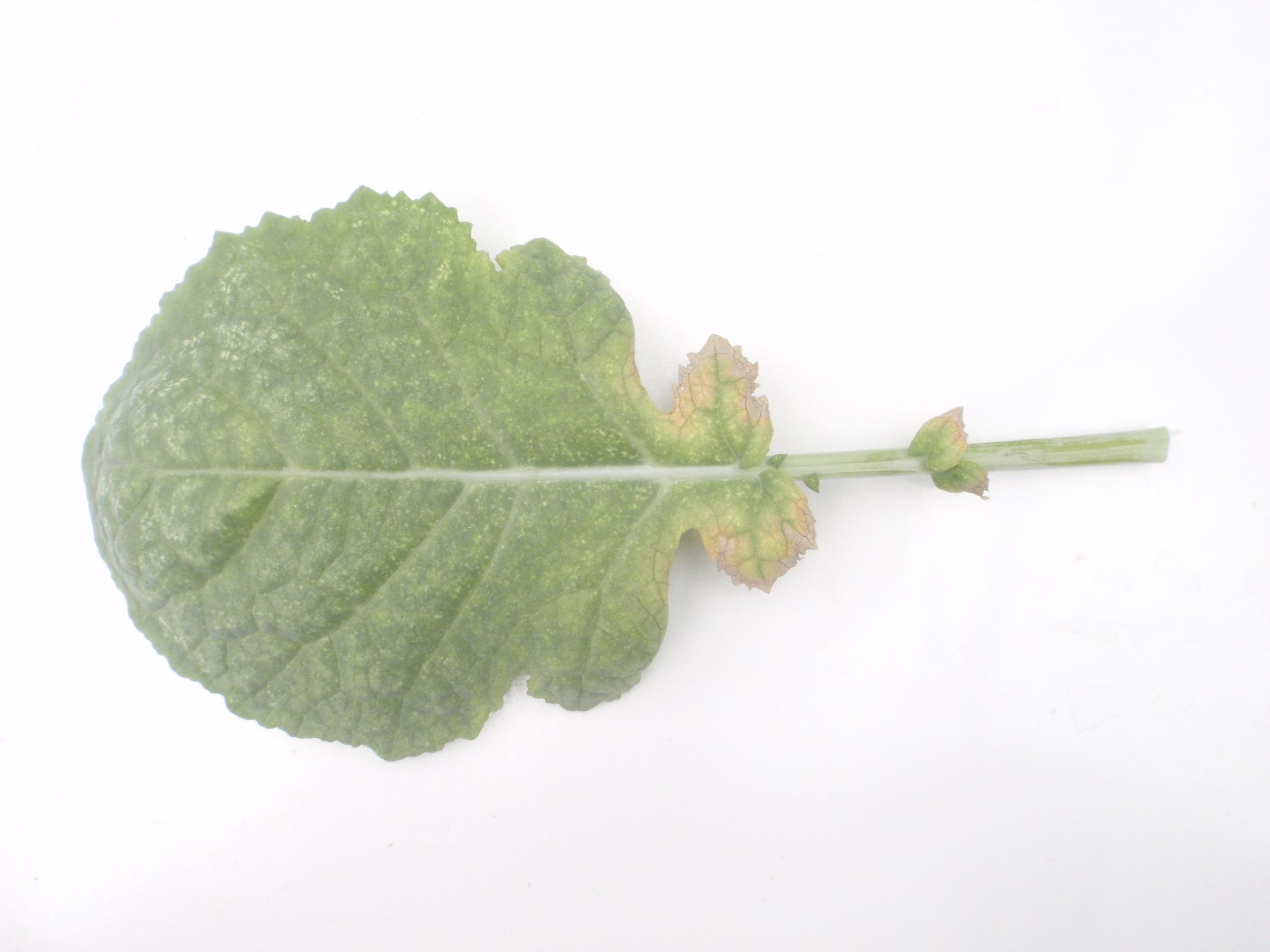
Figure 4: As calcium deficiency progresses, another indicator manifests as interveinal chlorosis especially near the petiole and leaf margin. This interveinal chlorosis will be accompanied with leaf distortion and small necrotic lesions. ©2018 Forensic Floriculture
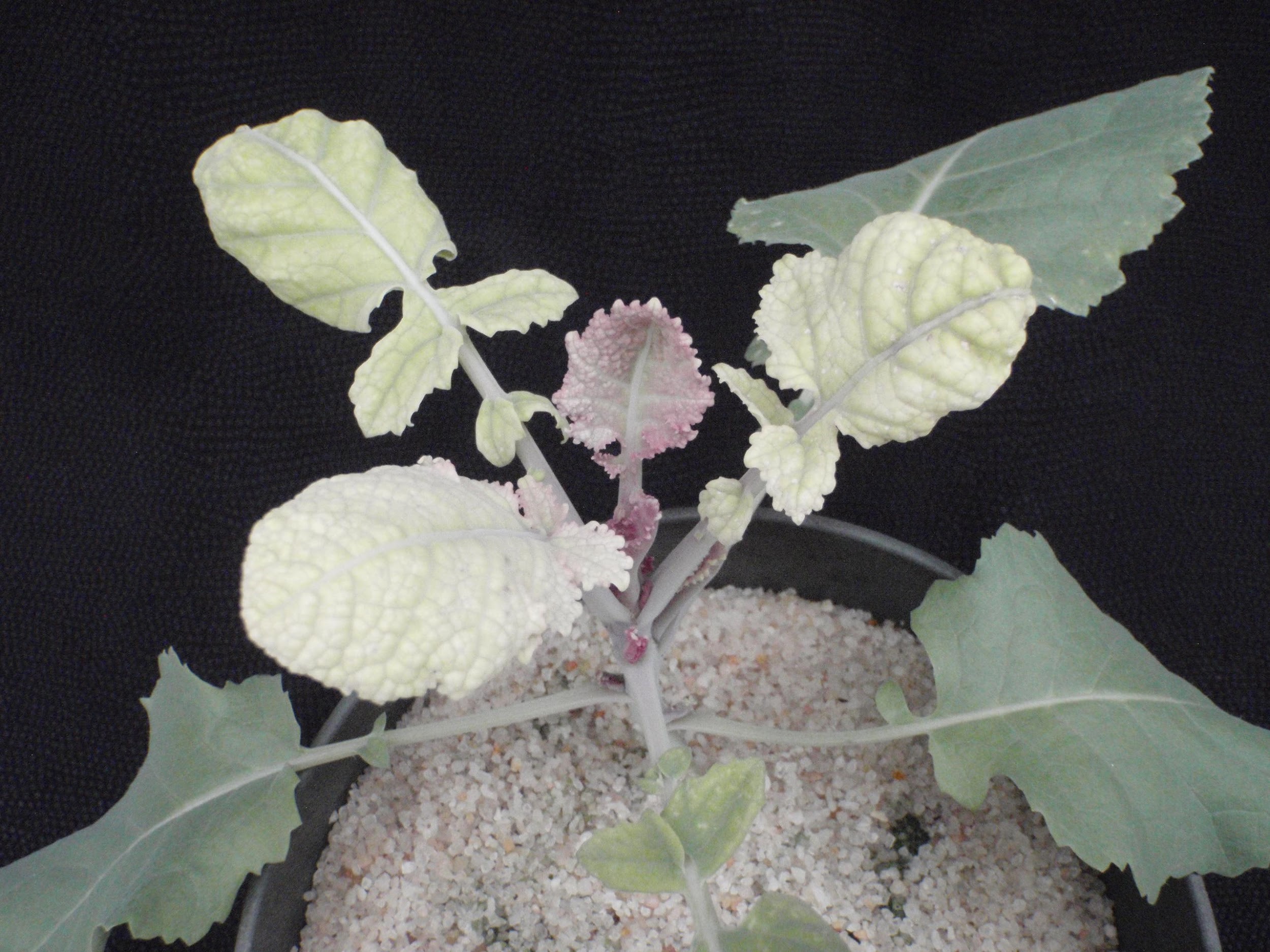
Figure 5: The expanding leaf above is displaying symptoms of marginal curling. In addition to these symptoms, note the red/purple/pink coloration of the newest foliage. This is another indicator of calcium deficiency conditions. ©2018 Forensic Floriculture
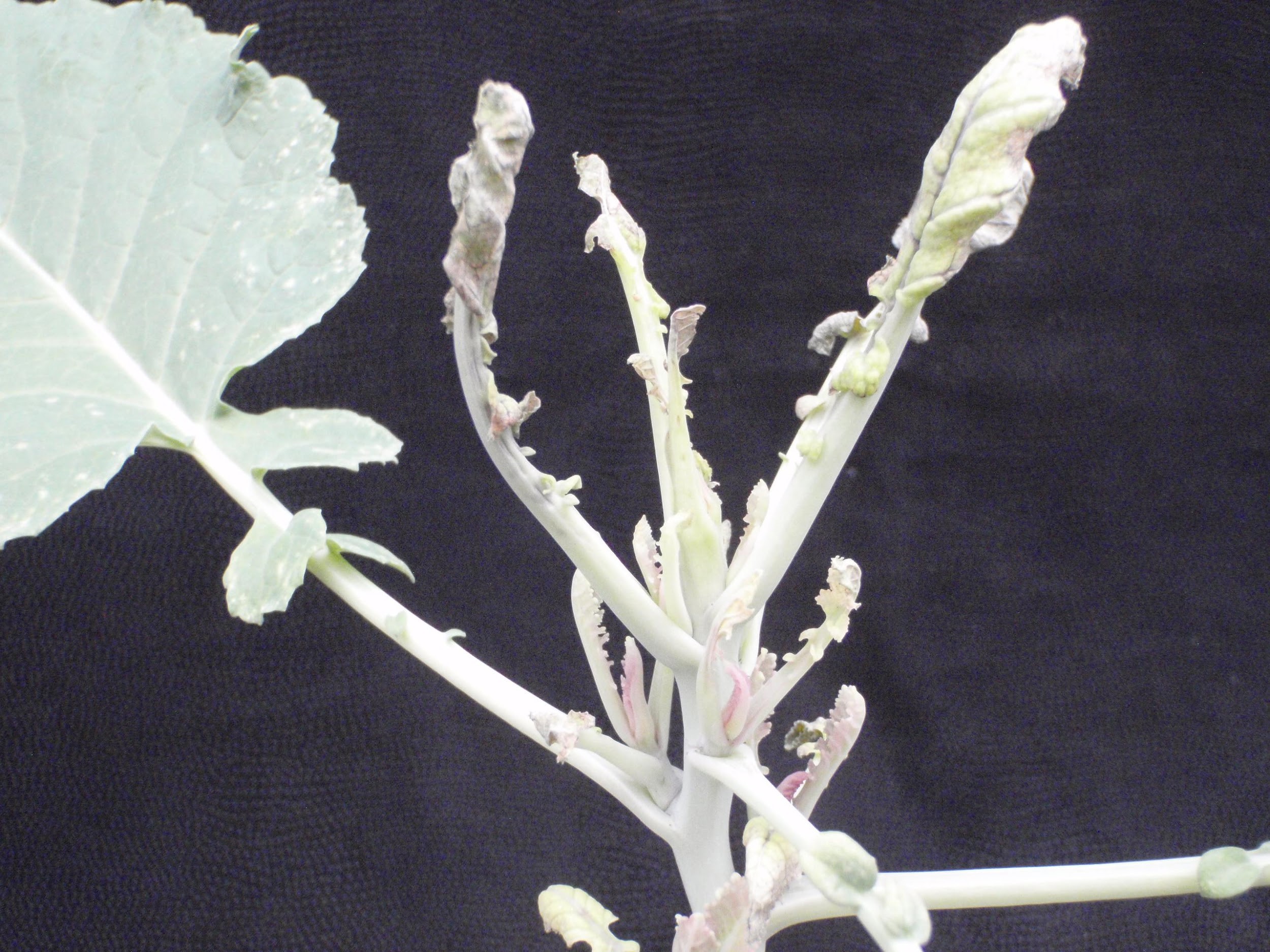
Figure 6: Eventually the calcium starvation will result in the death of the growing tip. This will cause the plant to start growth from the axillary shoots. As seen above, the axillary shoots are growing however they are severely distorted. Note specifically that the margin of the leaves cannot expand and this results in stalk like axillary shoots. ©2018 Forensic Floriculture




Key Contact Central East:
Dr. Angela Post, NC State Univ. Department of Crop and Soil Sciences – angela_post@ncsu.edu
Dr. Carl Crozier, NC State Univ. Department of Crop and Soil Sciences – ccrozier@ncsu.edu
Key Contact South East:
Dr. Michael Mulvaney, UF/IFAS West Florida Research and Education Center – m.mulvaney@ufl.edu
Primary Authors: Paul Cockson, Dr. Carl Crozier, Dr. Ramon Leon, Dr. Michael Mulvaney, Dr. Angela Post, and Dr. Brian E. Whipker
Project Team: NC State Univ. personnel Paul Cockson (NC State B.S. student in Agroecology), Ingram McCall (Research Technician in Horticultural Science at NC State), Dr. Carl Crozier (Professor and Extension Specialist at NC State), Dr. Ramon Leon (Assistant Professor at NC State), Dr. Angela Post (Assistant Professor and Extension Specialist NC State), and Dr. Brian Whipker (Professor of Floriculture and Plant Nutrition in Horticultural Science at NC State). Univ. of Florida personnel Dr. Michael Mulvaney (Cropping Systems Specialist at UF/IFAS West Florida Research and Education Center.
Suggested Citation:
Cockson, P.1, C. Crozier1, R. Leon1, M. Mulvaney2, A. Post1, B. Whipker1. 2018. Calcium Deficiency of Carinata. North Carolina St. Univ. Small Grains Portal – From the Field-Agronomy Notes.
1North Carolina State University
2University of Florida
Funding and Acknowledgments:
Funding for this work/study was received through USDA-NIFA Bioenergy Coordinated Agricultural Project (CAP). This material is based upon work that is supported by the National Institute of Food and Agriculture, U.S. Department of Agriculture.