North Carolina Wheat Disease Update 4/12/17
For wheat flowering now, scab risk is low across North Carolina. Risk is likely to remain low for the …


El inglés es el idioma de control de esta página. En la medida en que haya algún conflicto entre la traducción al inglés y la traducción, el inglés prevalece.
Al hacer clic en el enlace de traducción se activa un servicio de traducción gratuito para convertir la página al español. Al igual que con cualquier traducción por Internet, la conversión no es sensible al contexto y puede que no traduzca el texto en su significado original. NC State Extension no garantiza la exactitud del texto traducido. Por favor, tenga en cuenta que algunas aplicaciones y/o servicios pueden no funcionar como se espera cuando se traducen.
Inglês é o idioma de controle desta página. Na medida que haja algum conflito entre o texto original em Inglês e a tradução, o Inglês prevalece.
Ao clicar no link de tradução, um serviço gratuito de tradução será ativado para converter a página para o Português. Como em qualquer tradução pela internet, a conversão não é sensivel ao contexto e pode não ocorrer a tradução para o significado orginal. O serviço de Extensão da Carolina do Norte (NC State Extension) não garante a exatidão do texto traduzido. Por favor, observe que algumas funções ou serviços podem não funcionar como esperado após a tradução.
English is the controlling language of this page. To the extent there is any conflict between the English text and the translation, English controls.
Clicking on the translation link activates a free translation service to convert the page to Spanish. As with any Internet translation, the conversion is not context-sensitive and may not translate the text to its original meaning. NC State Extension does not guarantee the accuracy of the translated text. Please note that some applications and/or services may not function as expected when translated.
Collapse ▲For wheat flowering now, scab risk is low across North Carolina. Risk is likely to remain low for the …
This is the first North Carolina scab risk commentary for the 2017 scab monitoring season. In most of NC, …

During March 2017 the NCSU Plant Disease and Insect Clinic confirmed the presence of the bacterium Dickeya dianthicola on …
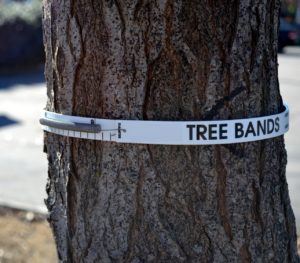
If you have a red maple (Acer rubrum) in your yard, and a few minutes of free time per …

Pine needle scales are relatively easy to find and to monitor for crawler activity. Stare at the needles of …

A team of University and Extension personnel from around the Southeast has created the 2017 Southeastern US Pest Control …
The state will be experiencing temperatures below freezing over the weekend and into next week. In North Carolina, temperatures …
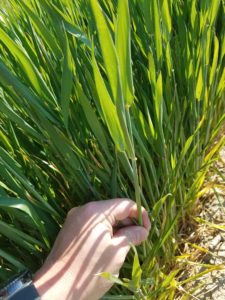
Early varieties at the Lenoir county OVT location are at or near flag leaf as of March …
We have started to stage our wheat plots at all 6 OVT locations. Preliminary notes are showing wheat jointing …
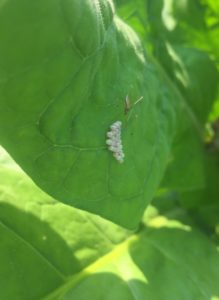
Graduate student Pete Nelson has been busy studying the biology of spined stilt bugs in tobacco in order to …

During 2016, our laboratory completed a three year project tracking the occurrence and impact of strawberry clipper weevil in annual, …

Last week the NCSU Plant Disease and Insect Clinic received three greenhouse samples of Pericallis x hybrida (florist’s cinerea) infected …

The public should be aware of the possibility of introducing boxwood blight into home landscapes not only on infected …
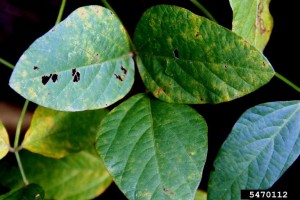
from Jim Dunphy, Crop Science Extension Specialist (Soybeans) and Lindsey Thiessen, Extension Plant Pathologist Asiatic Soybean Rust has been confirmed this …